Artificial intelligence is advancing faster than most organizations can adapt to it.
The technology itself is no longer the only challenge.
The larger question is how governments, companies, universities and technology builders can work together to turn AI into systems that create measurable value.
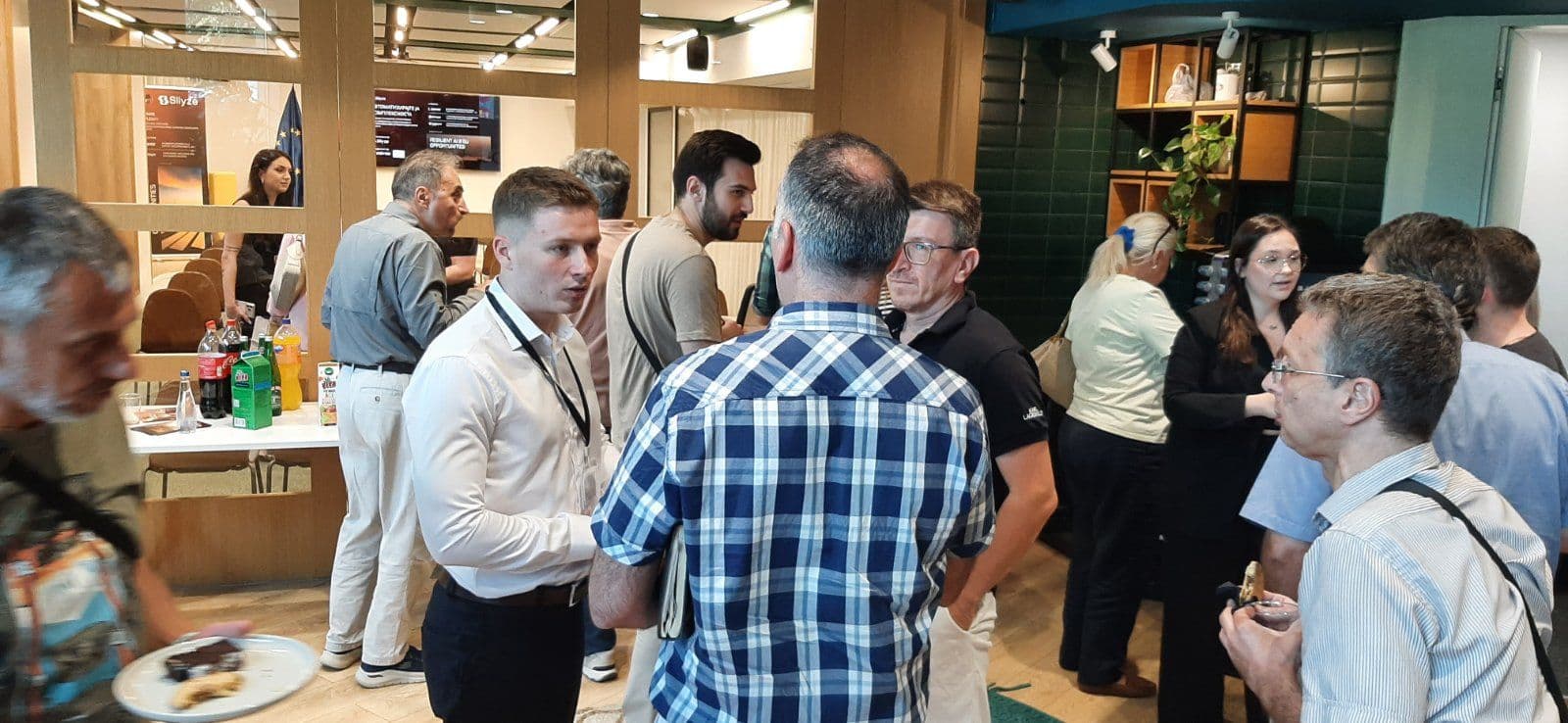
That was one of the central ideas behind “Resilient AI & EU Opportunities,” organized by Silyze at Europe House Skopje on July 29, 2026.

The event brought together representatives from public institutions, the energy sector, academia, private companies and the wider innovation ecosystem to explore how artificial intelligence can be applied in real organizational environments.
Rather than focusing only on the capabilities of new AI models, the discussion centered on what comes next: implementation, infrastructure, collaboration and the conditions needed for AI to become part of everyday operations.
A Shared Challenge Across Sectors
Government institutions and private companies often appear to operate in very different environments.
In practice, many of the challenges they face are increasingly similar.
Organizations across both sectors need to manage growing amounts of information, improve communication, modernize outdated processes, connect fragmented systems and make faster decisions based on better data.
Artificial intelligence can help address many of these problems.
But deploying AI successfully is rarely a purely technical exercise.
It requires access to reliable data, appropriate infrastructure, integration with existing systems, clear operational ownership, security standards and people who understand both the technology and the process it is intended to improve.
This is why collaboration between institutions, industry and technology companies is becoming increasingly important.
Creating a Common Space for Dialogue
“Resilient AI & EU Opportunities” was designed as a space where these different perspectives could meet.
Representatives from government institutions were able to hear directly from technology builders and companies working on new systems.
Private-sector participants could better understand the priorities and constraints faced by public institutions.
Technology teams could hear directly from the organizations expected to adopt and operate these systems.
And academic and innovation-sector representatives added another important dimension: research, talent development and access to programmes supporting innovation.
Bringing these groups together makes it possible to move discussions beyond general enthusiasm around AI and toward more practical questions.
Where can AI create immediate value?
Which systems need to be connected?
What infrastructure is required?
How should data be managed?
What should remain under human control?
And how can local organizations participate in the broader European technology ecosystem?
These are the questions that increasingly determine whether an AI initiative becomes a useful operational system or remains only a pilot.
The Role of Public Institutions
Public institutions have a particularly important role in the next stage of AI adoption.
They are not only potential users of artificial intelligence.
They also influence digital infrastructure, regulation, public services, education, energy policy and the environment in which technology companies operate.
During the event, representatives from several institutions participated in discussions around digital transformation, energy, innovation and the potential application of emerging technologies.
For Silyze, this interaction is important because many of the most meaningful applications of AI require cooperation across organizational boundaries.
A technology company can build a powerful platform, but transforming sectors such as energy, public administration or digital services requires coordination with the institutions and organizations already responsible for those systems.
Industry as the Environment Where AI Is Tested
Industry provides another essential part of this equation.
Companies operate under measurable pressure.
They need to reduce costs, improve customer experience, increase efficiency, manage risk and make better decisions.
This makes the private sector one of the most important environments for testing whether artificial intelligence delivers real value.
The involvement of businesses and energy-sector representatives at the event helped keep the conversation connected to practical use cases.
Artificial intelligence becomes meaningful when it can improve a workflow, reduce repetitive work, detect a problem earlier, automate communication, support an employee or help an organization understand its data more effectively.
That is also the context in which Silyze presented Telentir and Atmolyze.
Telentir addresses communication and voice automation.
Atmolyze focuses on energy, climate and operational intelligence.
The platforms are different, but both are designed around the same principle: AI should integrate into real systems and help organizations operate more effectively.
Universities and the Importance of Talent
No technology ecosystem can develop without talent.
Universities and academic institutions therefore play a critical role in the future of artificial intelligence.
As organizations begin adopting AI more seriously, demand will grow not only for software engineers and machine-learning specialists, but also for people who understand data, infrastructure, cybersecurity, energy systems, business processes and AI governance.
The gap between research and industry must become smaller.
Students need exposure to real-world problems.
Companies need access to skilled people.
Institutions need technical capacity.
And universities need stronger connections with the environments where emerging technologies are actually being deployed.
Events that bring these groups into the same conversation can help strengthen those relationships.
Interoperability as a Foundation
One of the most important themes underlying Silyze's approach is interoperability.
Most organizations already have technology.
They have databases, communication systems, operational platforms, internal software and external services.
The problem is often that these systems do not communicate effectively with one another.
Artificial intelligence creates an opportunity to introduce a new layer of intelligence across this fragmented environment.
But for that to work, systems need to exchange information securely and reliably.
This matters particularly in areas such as energy and public services, where important data may be distributed across several organizations.
Better interoperability can make it possible to build systems that provide a more complete picture of what is happening and support better decisions across institutions and companies.
For Silyze, AI and interoperability are therefore closely connected.
The future is not simply about building smarter individual applications.
It is about building smarter ecosystems.
Connecting Local Innovation With European Opportunities
The event also looked beyond North Macedonia.
European programmes continue to create opportunities for companies, institutions, universities and research organizations working on digitalization, artificial intelligence, energy and innovation.
Accessing those opportunities often requires collaboration.
A single company or institution may have strong technology or sector expertise, but European projects frequently depend on partnerships that combine several capabilities.
Technology companies may contribute software and AI expertise.
Universities can provide research capacity.
Public institutions can provide strategic and sectoral context.
Private companies can provide operational environments for testing and implementation.
Connecting these actors locally can therefore create stronger opportunities internationally.
For Silyze, building these relationships is part of a broader ambition to position locally developed technology within the European innovation ecosystem.
Moving Beyond Isolated AI Projects
The current AI wave has produced enormous interest in experimentation.
Organizations have tested chatbots, copilots, automation tools and generative AI platforms.
The next stage will require a more structured approach.
AI initiatives will need to connect to real data.
They will need clear responsibilities.
They will need measurable outcomes.
They will need security and governance.
And they will need to integrate with the systems organizations already use.
This is where cooperation becomes essential.
A technology provider alone cannot solve every organizational challenge.
A government institution alone cannot build every new technological capability.
And companies cannot modernize effectively without access to talent, infrastructure and a supportive ecosystem.
The strongest outcomes are likely to emerge when these groups work together.
Building the Ecosystem Around Practical AI
For Silyze, “Resilient AI & EU Opportunities” was not intended to be a one-time technology presentation.
It was part of a larger effort to create stronger relationships between people and organizations that can influence how artificial intelligence is adopted in North Macedonia.
We believe the country's size can also be an advantage.
Institutions, companies, universities and technology builders can connect more directly than in many larger markets.
That creates an opportunity to test ideas faster, develop collaborations and build solutions around real local needs before taking them into larger markets.
The future of artificial intelligence will not be determined only by who builds the most advanced models.
It will also be determined by who can integrate those technologies into useful systems, connect the right organizations and turn innovation into infrastructure.
That requires more than technology.
It requires an ecosystem.
And building that ecosystem is one of the conversations Silyze wants to continue.