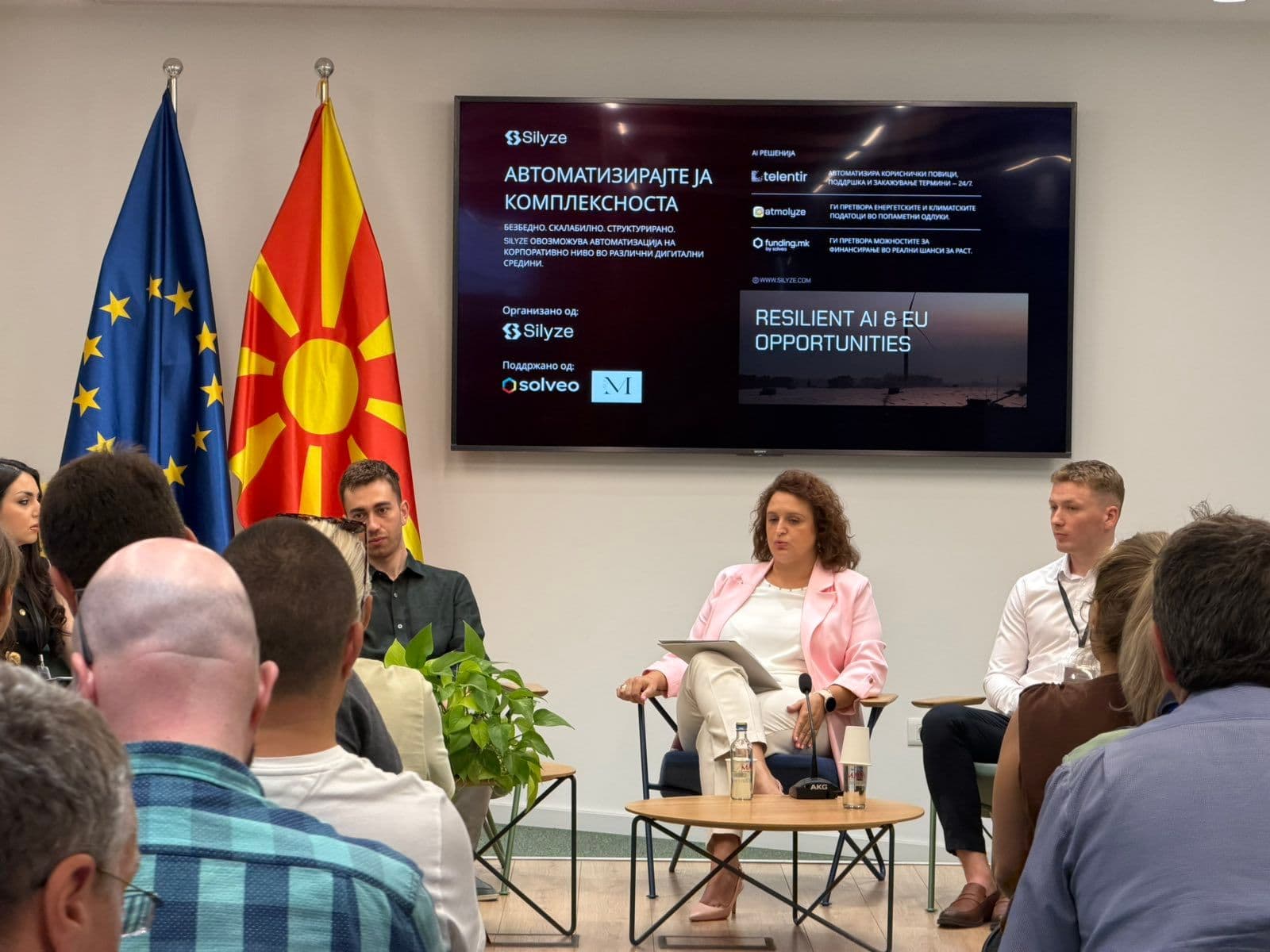
INOVA highlighted its participation in Silyze’s “Resilient AI & EU Opportunities” event, reinforcing one of the key themes behind the programme: meaningful digital transformation requires collaboration between technology companies, institutions and the wider business ecosystem.
At the invitation of Silyze DOOEL, Maja Cvetanovska from INOVA joined the event as a panelist and presented INOVA’s programme, with particular focus on activities and instruments that directly support the digitalization of enterprises.
Her contribution added an important institutional perspective to a programme centered on the practical application of artificial intelligence, digital transformation and European opportunities for innovation.
Digitalization Requires More Than Technology
For many companies, digital transformation begins with a technology decision.
In practice, successful transformation requires much more.
Organizations need access to expertise, financing, institutional support, suitable programmes and a clear understanding of where technology can create the greatest operational value.
This is why the involvement of institutions such as INOVA is important.
Technology companies can develop platforms and technical infrastructure, but broader adoption often depends on whether businesses also have access to the resources and support mechanisms required to implement those technologies effectively.
During the panel discussion, INOVA presented the instruments available to help enterprises move further along that journey.
Supporting Companies Through Digital Change
The transition toward more digital and AI-enabled operations can be challenging, particularly for smaller companies.
Businesses may understand that automation, data analytics or artificial intelligence could improve their operations, while still facing practical questions around implementation.
What should be digitalized first?
Which processes are suitable for automation?
How should a company evaluate a new technology?
What funding or support is available?
How can an organization modernize without creating unnecessary operational risk?
Programmes designed to support digitalization can help companies navigate these questions and reduce some of the barriers associated with technological change.
This institutional support becomes increasingly relevant as technologies such as artificial intelligence move from early experimentation toward mainstream business adoption.
AI as Part of the Digital Transformation Conversation
“Resilient AI & EU Opportunities” was built around the idea that artificial intelligence should be discussed as part of a broader transformation process.
AI is not valuable simply because a company adopts an AI tool.
Its value depends on where it is integrated and what problem it solves.
For some organizations, AI may improve communication with customers.
For others, it may support data analysis, forecasting, document processing or operational monitoring.
In the public sector, similar technologies may help improve accessibility, administrative processes or the way institutions interact with citizens.
The common requirement is a clear connection between technology and operational need.
That is where collaboration between technology providers, companies and institutional partners becomes particularly important.
Connecting Innovation With Available Support
The participation of INOVA also helped connect the technical side of innovation with the support environment surrounding it.
Companies developing or adopting new technologies often require more than software.
They may need financing, expert guidance, partnerships, opportunities for pilot implementation or support in accessing wider programmes.
By bringing these perspectives into the same event, Silyze aimed to create a more complete conversation around how innovation actually progresses from an idea to implementation.
It is one thing to demonstrate what artificial intelligence can do.
It is another to create the conditions that allow companies to adopt it successfully.
The Importance of Public-Private Collaboration
Digital transformation increasingly sits at the intersection of the public and private sectors.
Private companies develop and deploy new technologies at speed.
Public institutions help shape the environment in which those technologies are adopted through policy, programmes, funding and strategic initiatives.
When these groups operate separately, opportunities can be missed.
When they collaborate, companies gain a better understanding of available support and institutions gain direct insight into the challenges businesses face.
The participation of INOVA in the Silyze event reflected this type of exchange.
It created an opportunity to connect organizations developing new technologies with an institution focused on supporting companies through innovation and digital development.
Building a Stronger Local Innovation Ecosystem
For Silyze, strengthening these relationships is part of a broader objective.
North Macedonia has technology companies, startups, universities, public institutions and businesses with growing interest in digital transformation.
The challenge is connecting these actors more effectively.
Events such as “Resilient AI & EU Opportunities” can help create those connections by bringing together stakeholders who may otherwise interact only indirectly.
Technology companies gain greater visibility into institutional priorities.
Institutions hear directly from companies developing and implementing new solutions.
Businesses gain exposure to both new technologies and support programmes.
Over time, these relationships can contribute to a stronger and more connected innovation ecosystem.
From Local Collaboration to European Opportunities
The discussion also fits into a wider European context.
Digitalization, artificial intelligence, energy transformation and innovation remain important priorities across European programmes and initiatives.
For companies in North Macedonia, this creates opportunities to participate in broader projects, develop international partnerships and access programmes designed to support technological development.
However, participation in these opportunities often depends on strong local foundations.
Companies need capable teams.
Institutions need effective support mechanisms.
Technology providers need practical use cases.
And organizations need partners with complementary expertise.
Building these relationships locally can make it easier to participate internationally.
A Shared Goal Around Digital Development
INOVA’s message following the event emphasized its role as a partner for companies pursuing successful digital development.
That objective closely aligns with the purpose of “Resilient AI & EU Opportunities.”
Silyze’s role is to build technology and explore where artificial intelligence can create practical value.
INOVA’s role includes helping companies access programmes and instruments that support their development.
Businesses bring real operational challenges.
Public institutions bring strategic context and the ability to support broader transformation.
The strongest results are likely to come when these roles complement one another.
Continuing the Collaboration
We appreciate INOVA and Maja Cvetanovska for participating in “Resilient AI & EU Opportunities” and contributing an important institutional perspective to the discussion.
Their participation helped connect conversations around artificial intelligence with the broader realities of digital transformation: implementation, support, access to programmes and cooperation between institutions and businesses.
For Silyze, the event was designed as a starting point for exactly these kinds of relationships.
As artificial intelligence becomes more deeply integrated into companies and public-sector organizations, collaboration across the technology, institutional and business ecosystems will become increasingly important.
We look forward to continuing that dialogue and exploring further opportunities to support digital innovation in North Macedonia.