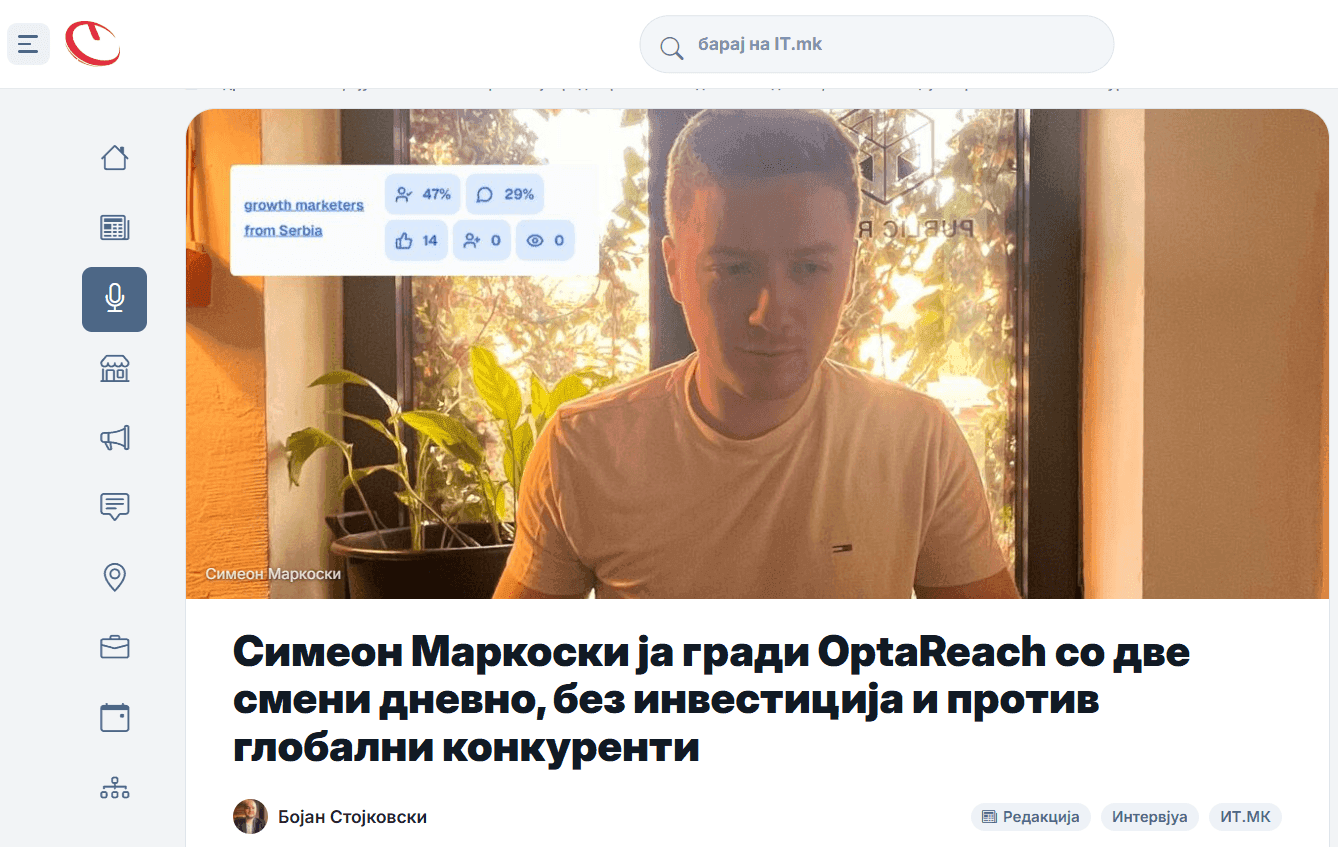
Silyze founder Simeon Markoski was featured in an in-depth interview by IT.mk, which explored the story behind OptaReach, the lessons learned from building technology products, and the realities of growing a bootstrapped SaaS company from North Macedonia.
The article follows a journey that began long before OptaReach.
Markoski spoke about his early involvement in technology competitions and hackathons, the experience of building and shutting down earlier products, working with clients, and eventually making the decision to focus fully on developing Silyze’s own software products.
Building OptaReach Around a Real B2B Problem
A major part of the IT.mk interview focused on OptaReach, Silyze’s multi-channel B2B outreach platform.
The product is designed to bring several outbound channels into one system, including LinkedIn, Reddit, X and email, so users can manage prospecting and conversations without relying on separate tools for every channel.
A central part of the platform is its unified inbox, which brings messages from different outreach channels into a single interface.
But the story behind OptaReach is not only about the product itself.
It is also about learning that building good software is only one part of building a company.
The Lesson That Changed the Way We Build
One of the most important themes in the interview was distribution.
Like many technical founders, Markoski spent long periods focused primarily on development.
The problem was straightforward: even excellent features create little value if the people who need them never discover the product.
The interview describes this shift from thinking primarily like a developer toward thinking like a founder responsible for sales, customer conversations, marketing and distribution.
This lesson has become a core part of how Silyze approaches product development.
Shipping technology matters.
But understanding the market, speaking directly with customers and building distribution around the product matters just as much.
Competing Globally From North Macedonia
OptaReach was never designed only for the local market.
From the beginning, the ambition has been to compete in the global B2B software market, even against companies with larger teams, stronger brands and significantly more resources.
IT.mk highlighted this contrast directly: Silyze is building with a small team while competing against established international companies.
For us, that competition is not a reason to avoid the market.
It is evidence that the market exists.
The challenge is to build a product that solves a clear problem, listen closely to users and move faster where a smaller company has an advantage.
Bootstrapping Instead of Raising Capital
Another major part of the feature was Silyze’s decision to continue building without external investment.
The development of OptaReach has been financed through Markoski’s own work and reinvestment into the product rather than through venture capital.
That approach creates constraints.
There is less room for unnecessary spending, slower experiments or building features without a clear reason.
But it also creates discipline.
Every product decision needs to move the company closer to users, revenue or a stronger product.
The long-term ambition remains significant, with the company focused on building recurring revenue progressively through customers rather than depending on investment rounds.
AI as a Tool, Not a Replacement for Fundamentals
The interview also explored Markoski’s perspective on artificial intelligence and software development.
AI is used in the development of OptaReach and can significantly improve speed and productivity.
But the article also emphasized an important point: AI does not remove the need for technical context or product understanding.
Developers still need to understand what they are building, why they are building it and whether it solves a meaningful problem.
This is increasingly relevant as AI tools become more accessible.
The barrier to building software may become lower.
The challenge of building something people genuinely need remains.
Beyond OptaReach: Building the Silyze Product Ecosystem
The IT.mk article also introduced Telentir, another platform being developed through Silyze.
Telentir is an AI voice platform designed for companies and public institutions that handle significant volumes of telephone communication.
The platform can automate common interactions such as frequently asked questions, information collection, appointment scheduling and callbacks, while routing more complex requests to the appropriate human operator.
Its inclusion in the interview reflects a broader direction for Silyze.
OptaReach focuses on outbound communication and sales infrastructure.
Telentir focuses on AI-powered voice communication.
Together with other Silyze initiatives, they represent our ambition to build practical technology products around real operational problems.
What It Means to Build as a Young Founder
IT.mk also explored the less visible side of entrepreneurship.
Building a company does not follow a predictable path.
There are periods with fewer customers, periods where investment into the product exceeds revenue, and moments where progress is difficult to see.
Markoski spoke openly about the importance of persistence during those periods and about continuing to work even when the outcome remains uncertain.
That perspective is important because entrepreneurship is often presented only through milestones.
The reality is much more repetitive.
It is product development, customer conversations, failed experiments, changes in direction and the decision to continue working the next day.
Building for the Long Term
OptaReach is still early in its journey.
The team continues to collect feedback from customers, improve the product and build stronger distribution around it.
For Silyze, the IT.mk feature captured an important moment in that process.
It documented not only what we are building, but also the thinking behind it: build products around real problems, stay close to users, learn distribution, remain resilient and compete beyond the boundaries of the local market.
We appreciate IT.mk and Bojan Stojkovski for taking the time to tell the story in depth and for bringing greater visibility to founders building technology products from North Macedonia. The interview was published on August 21, 2026.