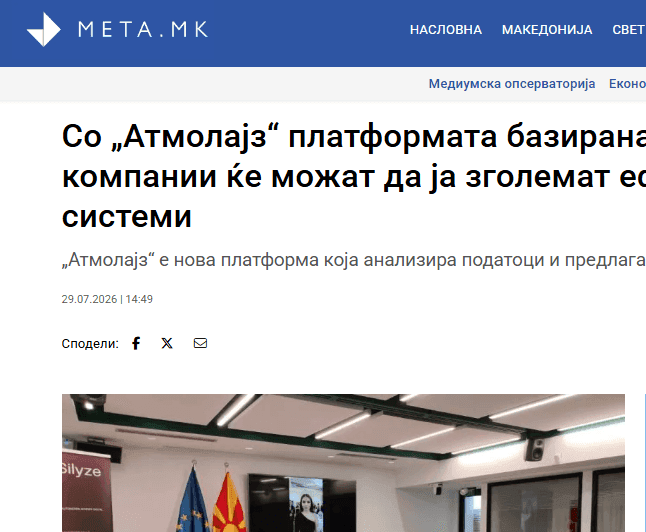
Silyze’s Atmolyze platform was featured by Meta.mk in an in-depth article exploring how artificial intelligence can help energy companies improve the efficiency, reliability and decision-making of solar and energy systems.
The article, published on July 29, 2026, focused on Atmolyze’s core objective: transforming complex operational and environmental data into actionable intelligence.
Rather than functioning only as a monitoring dashboard, Atmolyze is being developed as a decision-support platform capable of bringing together data from multiple sources, analyzing conditions in real time and helping organizations identify what requires attention.
Turning Energy Data Into Actionable Intelligence
Modern energy infrastructure generates a significant amount of information.
Solar installations, smart meters, energy consumption systems, tariff models, weather forecasts and operational equipment all produce data continuously.
The challenge for many organizations is not collecting this information.
It is interpreting it.
Meta.mk highlighted Atmolyze’s ability to collect and process information from different sources in real time and use artificial intelligence to help organizations understand what is happening across their operations.
This can include monitoring solar production, analyzing consumption patterns, comparing operational performance and identifying unusual changes before they develop into more serious problems.
For energy companies, having this information available in a single environment can make decision-making faster and more informed.
Detecting Problems Earlier
One of the capabilities highlighted in the article was anomaly detection.
Solar and energy systems can experience performance changes for a wide range of reasons.
A decrease in output may be caused by weather conditions, technical issues, equipment degradation, unexpected consumption patterns or another operational factor.
Traditional monitoring can show that something has changed.
The more important question is why.
Atmolyze is designed to analyze historical and real-time information to help identify unusual behavior and surface potential issues earlier.
Early detection can give operators more time to investigate a problem before it results in larger losses, downtime or equipment damage.
This is one of the areas where AI can create practical operational value: helping people focus on the situations that actually require attention.
Forecasting and Weather Intelligence
Meta.mk also highlighted the use of weather information within Atmolyze.
Weather conditions have a direct impact on solar energy production and on many other climate-dependent operations.
By combining weather forecasts with historical production and consumption data, an intelligent platform can provide organizations with additional context around expected performance.
This allows companies to move from reacting to current conditions toward planning for what may happen next.
Forecasting can support decisions related to production, consumption, maintenance, resource planning and operational scheduling.
The goal is not simply to predict the future with perfect accuracy.
It is to give decision-makers better information about likely scenarios and help them prepare earlier.
From Dashboards to Decision Support
A major theme behind Atmolyze is the transition from traditional monitoring toward intelligent decision support.
Many organizations already have dashboards.
They can see charts, metrics and historical reports.
But identifying what matters often still requires employees to manually inspect large volumes of information.
Atmolyze is being developed to help automate part of that interpretation.
The platform can support capabilities such as:
- real-time monitoring
- anomaly detection
- automated reporting
- energy forecasting
- cost analysis
- operational recommendations
- weather and climate intelligence
- planning and performance analysis
The objective is to help users understand not only what happened, but also what may happen next and what action may be worth considering.
That shift is central to Silyze’s vision for operational AI.
AI as an Operational Layer
Artificial intelligence creates the most value when it becomes part of the systems an organization already uses.
For energy companies, that means connecting AI with operational data, infrastructure, monitoring systems and external information sources.
Atmolyze is designed around this principle.
Instead of asking operators to work around a completely separate AI product, the platform aims to create an intelligence layer across existing operational information.
That can help organizations reduce fragmentation and build a more complete picture of their systems.
As energy infrastructure becomes increasingly digital, the ability to connect and analyze different data sources will become even more important.
Beyond the Energy Sector
The Meta.mk article also highlighted that the underlying technology has potential applications outside energy.
Climate conditions and operational data influence industries such as agriculture and construction, where organizations also need to understand environmental conditions, resource consumption and operational risks.
This creates a broader opportunity for Atmolyze.
The platform is initially strongly connected to energy and solar use cases, but the underlying approach — combining operational, environmental and external data to improve decisions — can be applied across multiple industries.
For Silyze, this is one of the more interesting possibilities surrounding the platform.
The same intelligence layer can potentially support different organizations by adapting to the data and operational challenges specific to each sector.
Building More Resilient Operations
Climate change is also increasing the importance of better operational intelligence.
More volatile weather conditions can affect energy production, infrastructure, agriculture, construction and other industries.
Organizations increasingly need systems that help them understand how external conditions influence their operations.
This is where the idea of resilience becomes important.
A resilient organization is not one that never experiences disruption.
It is one that can identify change, understand its impact and respond quickly.
Atmolyze is being developed to support this type of decision-making by providing organizations with more timely and contextual information.
Complementing Technology With Human Expertise
Atmolyze is not intended to remove human decision-making from complex operational environments.
Energy systems involve technical, financial and strategic decisions where human expertise remains essential.
The role of AI is to help experts process more information, identify patterns more quickly and surface insights that may otherwise be difficult to detect.
A system might detect an anomaly.
A human operator determines the appropriate response.
A forecast might indicate a potential risk.
A manager decides whether and how to adjust operations.
This combination of automated intelligence and human expertise is likely to define many of the most valuable enterprise AI applications.
Telentir Also Featured
The Meta.mk article also referenced another Silyze technology presented during the event: Telentir, our AI voice platform.
The platform is designed for companies and institutions that handle significant volumes of phone communication.
By automating recurring interactions such as frequently asked questions, appointment scheduling and basic information requests, organizations can reduce the workload placed on operators and allow employees to focus on more complex conversations.
The inclusion of both platforms in the coverage demonstrated the range of operational areas Silyze is exploring with artificial intelligence, from communication to energy and data intelligence.
A Broader Ecosystem Around Innovation
The article also featured Nikola Angelovski from Solveo, who presented the Funding platform and discussed how AI can help companies discover relevant opportunities for financing projects through European funds.
This added another dimension to the event.
Innovation is not only about developing technology.
It is also about connecting companies with the funding, partnerships and institutional support needed to implement and scale new ideas.
Bringing technology, energy, financing and public-sector perspectives together was one of the central objectives of “Resilient AI & EU Opportunities.”
From an Idea to Real Infrastructure
The Meta.mk feature reflects the direction Silyze is pursuing with Atmolyze.
The goal is not to build another dashboard.
It is to build a platform capable of helping organizations understand complex systems and make better operational decisions.
Artificial intelligence can process larger amounts of information than a person could reasonably review manually.
But the technology becomes valuable only when those insights are delivered in a form that helps someone act.
For Atmolyze, that means bringing together live monitoring, historical data, forecasting, anomaly detection and recommendations in one environment.
The longer-term vision is an intelligence platform that helps organizations operate with greater awareness, efficiency and resilience.
Growing Recognition for Atmolyze
The feature by Meta.mk represents an important moment for Atmolyze as the platform continues to develop.
Independent coverage helps bring the conversation around energy intelligence to a wider audience and provides greater visibility into the practical problems Silyze is working to solve.
Energy systems are becoming more distributed, data-intensive and complex.
Solar installations are growing.
Climate conditions are becoming more important.
And organizations are generating more information than ever before.
The opportunity is to make that information useful.
We appreciate Meta.mk and Sanja Naumovska for taking a deeper look at Atmolyze and the potential role artificial intelligence can play in creating more efficient and resilient energy operations.