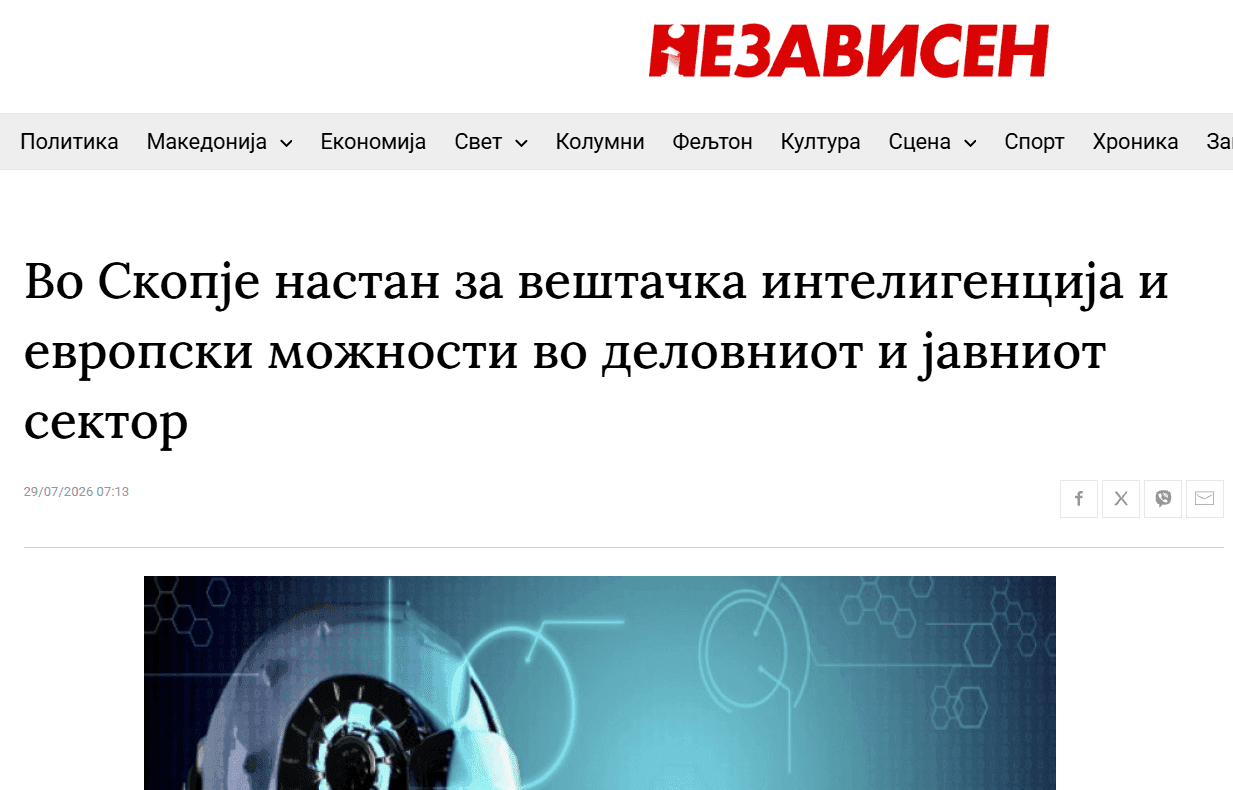
Silyze’s “Resilient AI & EU Opportunities” event was featured by Nezavisen ahead of its July 29, 2026 programme at Europe House Skopje.
The publication highlighted the event’s focus on the application of artificial intelligence across the business and public sectors, as well as the opportunities available through European programmes supporting digital transformation and innovation.
The coverage also introduced two of the technologies at the center of the event: Silyze’s AI voice technology with support for the Macedonian language and Atmolyze, our platform for climate, energy and operational intelligence.
For Silyze, the feature helped extend an important conversation beyond the technology ecosystem: artificial intelligence is becoming increasingly relevant not only as an emerging field, but as a practical layer that can improve how organizations communicate, operate and make decisions.
Artificial Intelligence With a Practical Focus
Nezavisen emphasized that the event would present current trends alongside practical AI solutions.
This distinction is important.
Artificial intelligence has developed rapidly in recent years, but for most organizations the key question is no longer simply what AI can do.
The more important question is where it can create measurable value.
That may involve automating repetitive communication, helping employees access information more quickly, detecting unusual operational behavior, analyzing large volumes of data or supporting better decision-making.
“Resilient AI & EU Opportunities” was created around this practical perspective.
The goal was to bring together people from different sectors and explore how AI technologies can move from demonstrations and experimentation into real organizational environments.
Voice AI in the Macedonian Language
One of the solutions highlighted by Nezavisen was an AI voice agent capable of communicating in Macedonian.
Voice communication remains essential for many companies and public institutions.
Customers and citizens continue to rely on telephone communication for support, information, scheduling, administrative requests and other services.
At the same time, many of these interactions are repetitive and require significant staff time.
AI voice agents can help organizations automate part of this communication while maintaining a conversational interface that is familiar to users.
Supporting Macedonian is particularly important in this context.
For local organizations, AI cannot become broadly useful if users are forced to communicate in a foreign language or if the system struggles to understand the nuances of local speech.
Silyze is therefore working to make voice AI more accessible to organizations operating in North Macedonia and to build systems that can be integrated into existing communication workflows.
Improving Communication Without Removing the Human Element
The objective of voice automation is not to eliminate human interaction.
There are many conversations where human judgment, empathy and contextual understanding remain essential.
The opportunity lies in allowing AI to handle interactions that are predictable and repetitive.
A voice system may answer frequently asked questions, collect initial information, provide a status update, schedule an appointment or direct a user to the appropriate department.
More complex situations can then be escalated to a human employee.
This creates a hybrid model where automation supports people rather than simply replacing them.
For organizations, that can mean shorter waiting times, more consistent service and more time for employees to focus on higher-value tasks.
Atmolyze and the Future of Operational Intelligence
Nezavisen also highlighted Atmolyze, Silyze’s platform for climate, energy and operational intelligence.
Atmolyze is being developed to help organizations make sense of increasingly complex operational environments.
Modern companies and infrastructure systems generate large volumes of information from energy production, consumption, weather conditions, equipment, sensors and other operational sources.
Having access to that information is useful.
Understanding it is more valuable.
Atmolyze is designed to bring information from different sources together and apply advanced analytics and artificial intelligence to help organizations understand what is happening across their systems.
The aim is to support more informed decisions, identify unusual conditions earlier and help organizations use their resources more efficiently.
From Data Visualization to Decision Support
Traditional analytics platforms often focus on presenting information.
Charts, dashboards and reports show what happened.
The next generation of operational technology needs to go further.
Organizations increasingly need systems capable of recognizing patterns, identifying anomalies, forecasting future conditions and helping users understand what deserves their attention.
This transition from data visualization toward decision support is one of the central ideas behind Atmolyze.
In energy environments, for example, organizations may need to understand whether a change in production is expected, weather-related or a potential technical issue.
In industrial settings, operational data may reveal patterns that can help identify inefficiencies before they become larger problems.
Artificial intelligence creates an opportunity to interpret this information at a scale and speed that would be difficult to achieve manually.
AI Across the Public and Private Sectors
The Nezavisen coverage also reflected the cross-sector focus of the event.
Artificial intelligence is often discussed primarily in the context of private companies and productivity.
Its potential application is much broader.
Public institutions also manage complex processes, large volumes of information and significant levels of communication with citizens.
AI can potentially support administrative workflows, citizen services, internal knowledge management and the analysis of operational information.
However, public-sector implementation also introduces additional considerations around security, privacy, transparency and infrastructure.
This makes collaboration between technology providers and institutions especially important.
Successful adoption requires understanding not only the technology, but the environment in which it will operate.
Digital Transformation Is More Than Software
The event also focused on digital transformation more broadly.
Technology alone does not transform an organization.
Successful transformation requires processes, infrastructure, data, people and clear objectives to work together.
Introducing AI into an inefficient or fragmented workflow without addressing the underlying process may simply create another layer of complexity.
Silyze’s approach is therefore centered on understanding the operational problem first and identifying where technology can make that process better.
In some environments, the right solution may be automation.
In others, the greater opportunity may be integration, analytics or better access to existing information.
The technology should follow the problem.
Connecting Innovation With European Opportunities
Another key theme highlighted by Nezavisen was the role of European programmes supporting innovation and digital transformation.
European initiatives create opportunities for companies, public institutions, research organizations and universities to develop new technologies, participate in international projects and collaborate across borders.
For organizations in North Macedonia, these programmes can provide access not only to funding, but also to knowledge, partners and larger environments in which new technologies can be tested and developed.
Connecting local innovation with the wider European ecosystem was therefore an important part of the conversation around the event.
Silyze sees international collaboration as an important path for technologies developed locally to reach larger markets and contribute to broader European initiatives around AI, digital infrastructure and energy transformation.
Building Technology Around Real Needs
The technologies highlighted by Nezavisen represent two different areas of AI development.
Voice AI focuses on how organizations communicate.
Atmolyze focuses on how organizations understand and act on operational information.
But the underlying principle is the same.
Artificial intelligence should solve a clearly defined problem.
It should work with existing organizational processes.
And its value should ultimately be measurable through better outcomes.
For Silyze, this practical approach is more important than simply adopting the newest technology.
Our goal is to develop systems that organizations can actually use.
Continuing the Conversation
Media coverage from outlets such as Nezavisen helps bring discussions about artificial intelligence, digital transformation and energy technology to audiences beyond the traditional technology community.
That matters because the next stage of AI adoption will involve a much broader range of organizations.
Business leaders, public institutions, energy companies, universities and policymakers will all play a role in determining how these technologies are implemented.
“Resilient AI & EU Opportunities” was designed to create a space for those perspectives to meet.
We appreciate Nezavisen for highlighting the event and helping bring greater visibility to the practical opportunities surrounding artificial intelligence, digital transformation and intelligent infrastructure in North Macedonia.